Tender Teardown
This tender involves significant modifications to an existing cattle housing unit, including roof raising, new slatted tanks, and a lean-to, where a tight 4-month programme and extensive contractor responsibilities for site verification and design make the commercial risk profile critical for bidders.
126 01 EXISTING SHED: Tender Teardown
This tender involves significant modifications to an existing cattle housing unit, including roof raising, new slatted tanks, and a lean-to, where a tight 4-month programme and extensive contractor responsibilities for site verification and design make the commercial risk profile critical for bidders.
This commission focuses on substantial modifications to an existing cattle housing unit, identified as 126 01 EXISTING SHED. The scope includes raising the roof, installing new slatted tanks, and constructing a lean-to extension. The programme is notably tight, running from September to December 2026, a mere four months. The buyer explicitly requires the Project Supervisor Construction Stage (PSCS) to assess the achievability of this timeline, which suggests the client recognises the inherent challenge.
Operating on a fixed-price lump sum basis, this project places significant commercial risk on the contractor. The dossier reveals several critical areas where the contractor assumes extensive responsibility, from site verification and design elements to managing client-appointed third parties. Bid teams must scrutinise these clauses to accurately price the true cost and programme implications, rather than carrying silent risk that could erode margins or lead to disputes.
Bill of Quantities excluded from fixed-price lump sum contract
Critical · Boq Rule Conflict
The tender documents explicitly state that any Bill of Quantities (BOQ) or Schedule of Rates, while provided for pricing, will not form part of the final contract. This is a critical commercial point for a fixed-price lump sum procurement. It means the contractor carries the full risk of any quantity discrepancies between the BOQ used to formulate the price and the actual quantities required to complete the works as defined by the drawings and specifications.
If the BOQ understates quantities for specific elements, the contractor will be obliged to complete the full scope for the lump sum price, absorbing any additional material, labour, or plant costs. This shifts the burden of accurate quantity take-off entirely onto the bidder, demanding a comprehensive re-measurement exercise during the tender period to avoid significant cost overruns.
All other documents, including Documents for information purposes only, made available to Applicants will not form part of the Contract such as: ... any Bill of Quantities
What we'd do: Conduct a full quantity take-off from the drawings and specifications, cross-referencing against the provided BOQ. Price for the full scope, not just the BOQ, and raise a formal query if the client expects the BOQ to be the sole basis for pricing.
Fitness for purpose obligation raises liability bar
Critical · Warranty Overreach
The requirement to 'Test and demonstrate fitness for purpose' for certain elements imposes a strict liability standard on the contractor. This goes beyond the typical 'reasonable skill and care' standard usually expected in construction contracts. Under a fitness for purpose obligation, the contractor warrants that the works will be suitable for their intended use, regardless of whether they exercised due care in their design or construction.
This higher standard significantly increases the contractor's exposure to risk. It could lead to higher costs for more extensive testing, quality assurance, and potential rectification works if the completed elements do not meet the strict performance criteria, even if built to specification. Bid teams must understand the specific elements this applies to and assess the commercial implications.
Test and demonstrate fitness for purpose where required by the engineer or Employer.
What we'd do: Identify all elements subject to 'fitness for purpose'. Price in the additional testing, quality control, and potential rectification costs. Consider a pre-tender query to clarify the exact scope and definition of 'fitness for purpose' for these items.
Electronic submission failure means outright rejection
Critical · Portal Submission Failure
The tender instructions are clear: the responsibility for a timely, complete, and uncorrupted electronic submission rests solely with the tenderer. Any failure, whether due to late submission, incomplete files, corruption, or unviewable documents, will result in the tender being rejected. This is not a point for negotiation or leniency; it is an absolute gateway requirement.
The practical consequence is that all effort invested in preparing a competitive bid can be nullified by a technical glitch or last-minute rush. Bid teams must treat the submission process with the same rigour as the pricing and technical proposals, ensuring system compatibility, sufficient upload time, and file integrity well in advance of the deadline.
Tenders must be received in accordance with the required means of tender delivery stated in the Particulars and by no later than the deadline stated in the Particulars (or a later date and time advised by the Contracting Authority to Tenderers).
Where the Particulars state that the required means of tender delivery is electronic submission to the eTenders platform, Tenderers are advised to ensure that they give sufficient time to allow for the successful upload of all Tender documents and that they have a reliable, continual connection speed available for this purpose.
What we'd do: Plan for electronic submission at least 24 hours before the deadline. Conduct a dry run of the upload process, verify all files are viewable and uncorrupted, and ensure a stable internet connection. Do not leave submission to the last hour.
Contractor owns site verification and discrepancy risk
Critical · Scope Gaps
The tender documents explicitly place the onus on the contractor to inspect the existing building, verify all dimensions and levels on site, and allow for integration with existing structures and services. Furthermore, it states that no dimensions shall be scaled from drawings and any discrepancy must be raised before works proceed. This transfers significant risk to the contractor.
This means any unforeseen conditions, incorrect dimensions on drawings, or discrepancies between documents and the actual site, if not identified and formally raised during the tender period, will likely become the contractor's cost and programme risk. It demands a thorough, pre-bid site survey and a proactive approach to clarification queries, as relying on provided information without verification is not an option.
Tenderers shall inspect the existing building, verify dimensions and levels on site, and allow for protection, temporary support, alteration, making good and integration with existing structure, floors, services, roof and drainage.
Dimensions shown include metric references and must be verified on site before ordering, fabrication or construction. No dimension shall be scaled from the drawings (APPENDIX A). Written dimensions and site-verified dimensions shall take precedence. Any discrepancy shall be raised before works proceed.
What we'd do: Conduct a detailed site survey and dimension verification before pricing. Document all existing conditions, identify potential clashes or discrepancies, and submit formal clarification requests for any ambiguities or conflicts found. Price in a contingency for minor, unclarified risks.
Undisclosed conflicts of interest lead to exclusion
Critical · Exclusion Ground Exposure
The tender requires full disclosure of any actual or potential conflicts of interest, including 'registrable interests', as soon as they become apparent. Failure to do so gives the Contracting Authority absolute discretion to exclude the applicant from the competition. This is a fundamental integrity requirement that can immediately disqualify a bidder.
This clause is not merely a formality; it is a direct exclusion ground. Bid teams must ensure that their organisation, and any key personnel involved, have no undisclosed relationships or interests that could be perceived as a conflict. A robust internal review process is essential before submission to avoid an immediate and irreversible rejection.
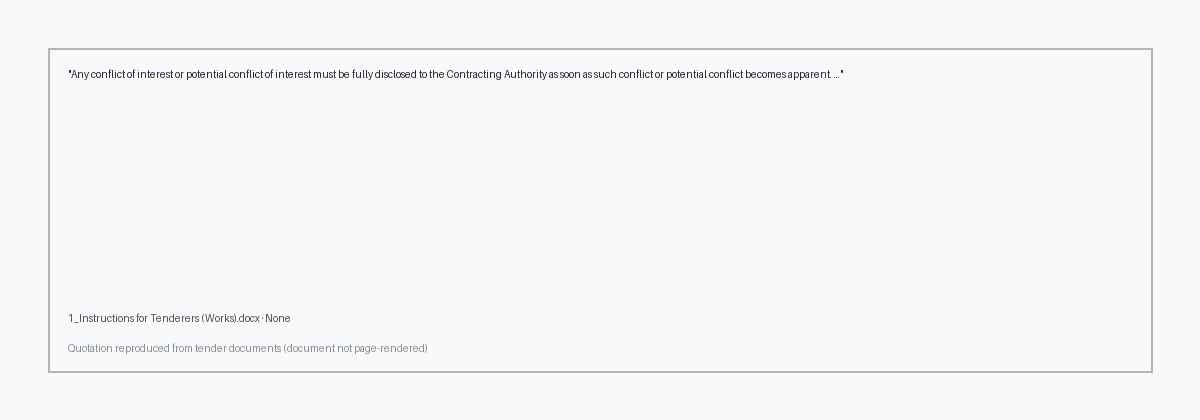
Any conflict of interest or potential conflict of interest must be fully disclosed to the Contracting Authority as soon as such conflict or potential conflict becomes apparent. ...
The Contracting Authority will, at its absolute discretion, decide on the appropriate course of action in relation to any actual or perceived conflict of interest which may include (but is not limited to) excluding the Applicant from the Competition or permitting the Applicant to continue subject to safeguards determined by the Contracting Authority being put in place and observed.
What we'd do: Implement a mandatory internal conflict of interest declaration for all bid team members and key personnel. Fully disclose any identified conflicts or 'registrable interests' to the Contracting Authority immediately, seeking their guidance on mitigation measures if permitted.
Tax compliance is a condition of contract award
Critical · Mandatory Declaration Gap
Compliance with all applicable EU and domestic tax laws is a condition for the award of the contract, not just a tender stage requirement. The successful tenderer must provide their Tax Clearance Access Number and Tax Reference Number to allow online verification of their tax status. Failure to meet this condition will prevent contract award.
This is a non-negotiable pre-condition for entering into a contract. It means that even if a contractor submits the most competitive bid, they will not be awarded the work if their tax affairs are not in order or if they cannot provide the necessary verification details. Bid teams must ensure their company's tax compliance is current and that the required information is readily available.
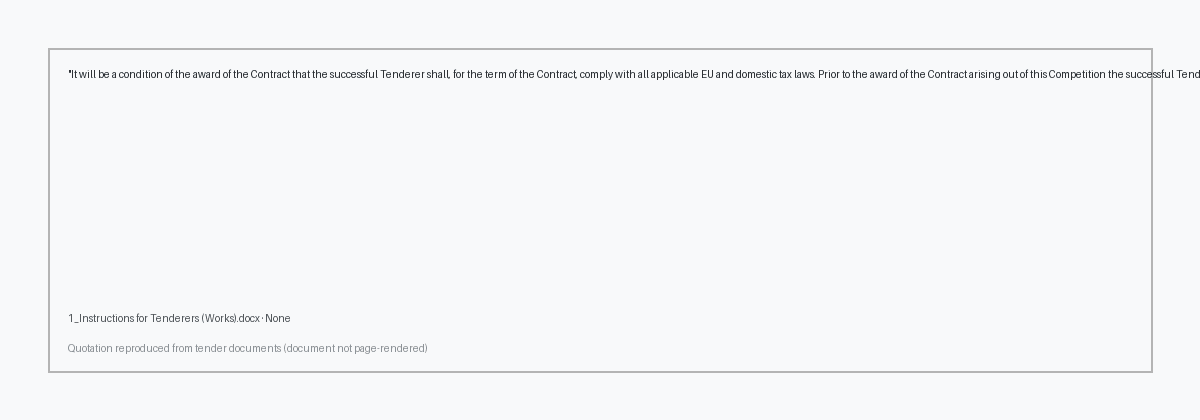
It will be a condition of the award of the Contract that the successful Tenderer shall, for the term of the Contract, comply with all applicable EU and domestic tax laws. Prior to the award of the Contract arising out of this Competition the successful Tenderer shall be required to supply its Tax Clearance Access Number and Tax Reference Number to facilitate online verification of their tax status by the Contracting Authority.
The Letter to Successful Tenderer should request the Tenderer to submit to the Contracting Authority any or all of the following: ... evidence of tax compliance from the Revenue Commissioners
What we'd do: Confirm current tax compliance status with the finance department. Ensure the Tax Clearance Access Number and Tax Reference Number are readily available and valid for immediate submission upon request from the Contracting Authority.
The rest of the picture
Beyond the critical risks detailed, bidders should note the dependency on the client's existing electrical contractor, which creates a significant interface risk for programme and coordination. The contractor also assumes design responsibility for structural elements and tanks, requiring specialist input and professional indemnity cover. Furthermore, the contractor is automatically appointed Project Supervisor for Construction Stage (PSCS), adding substantial health and safety management obligations. The short 4-month programme, already highlighted as potentially unrealistic by the client, will be further strained by these dependencies and responsibilities.
Takeaways
- Conduct a full quantity take-off and site survey to mitigate the non-contractual BOQ and site verification risks.
- Thoroughly assess and price the 'fitness for purpose' obligation, considering increased testing and liability.
- Prioritise electronic submission well in advance of the deadline, verifying file integrity.
- Perform a robust internal review for conflicts of interest and ensure full tax compliance for contract award.
- Factor in the programme impact and coordination effort for the client's electrical contractor and the PSCS role.