Tender Teardown
This tender involves the construction of new changing rooms and a gym within an active sports complex, presenting a high-risk profile due to an aggressive programme, significant site condition liabilities, and extended warranty obligations.
Proposed New Changing Rooms and Gym Construction: Tender Teardown
This tender involves the construction of new changing rooms and a gym within an active sports complex, presenting a high-risk profile due to an aggressive programme, significant site condition liabilities, and extended warranty obligations.
The commission is for the construction of new changing rooms and a gym. This project is situated within a fully operational sports complex, with other building activities nearby and in close proximity to residential and commercial properties. This environment demands rigorous health and safety management, traffic control, and public protection measures. The programme specifies a 45-day completion time, which is an extremely tight schedule for this type of construction, compressing procurement and specialist subcontractor availability. An inconsistency exists in the documentation, with some parts referring to a 'healthcare complex' while others consistently mention a 'rugby club', a detail that needs clarification but does not diminish the inherent risks of working in an operational facility. Asbestos is also presumed present, with the contractor responsible for its investigation and removal.
These project specifics, coupled with the contract's risk allocation, mean bidders face substantial commercial exposure. The tender documents place significant responsibility on the contractor for site conditions, programme delivery, and long-term performance. Understanding these explicit and implicit risks is crucial for accurate pricing, effective programme planning, and ultimately, a successful bid.
Addenda or revision mismatch
High · General
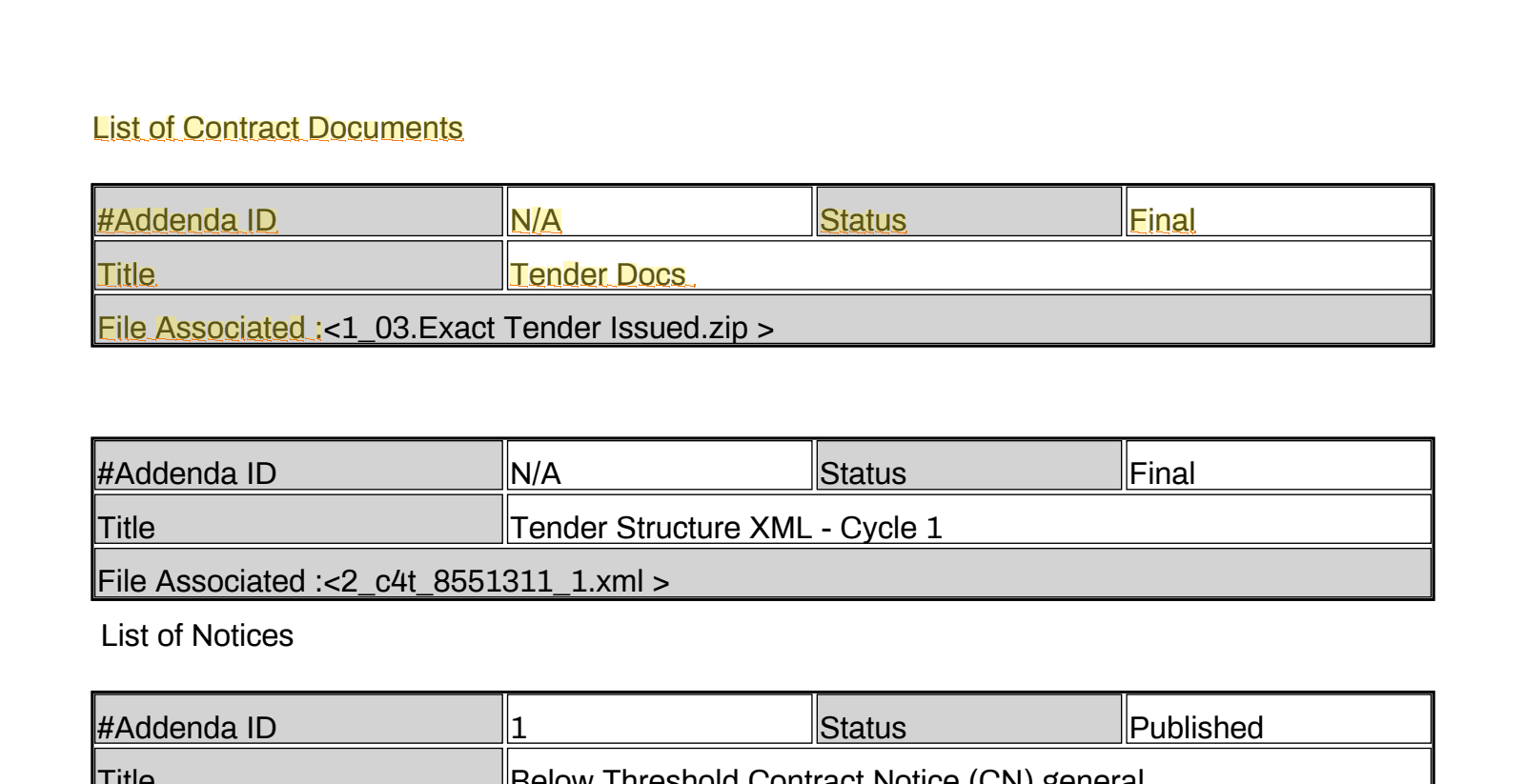
The tender documents list a single "Tender Docs File Associated" without clear addenda IDs or version control. This lack of explicit revision tracking creates a risk that bidders might work from an outdated or incomplete set of documents, especially if updates or clarifications were issued without a formal, version-controlled addendum process. Bidding against superseded requirements can lead to pricing errors, scope gaps, or non-compliance.
Without a clear audit trail for document revisions, any post-award disputes over scope or specification could become protracted. The onus would be on the contractor to prove which version of the documents they priced against, which is difficult if the employer's records differ. This uncertainty directly impacts the certainty of the lump sum price.
134572_8551311.pdf List of Contract Documents #Addenda ID N/A Status Final Title Tender Docs File Associated :<1_0
What we'd do: Request a formal list of all issued documents and addenda with clear version numbers and issue dates, and confirm that the submitted tender will be assessed against this definitive list.
Aggressive 45-Day Time for Completion
Critical · Long Lead Procurement
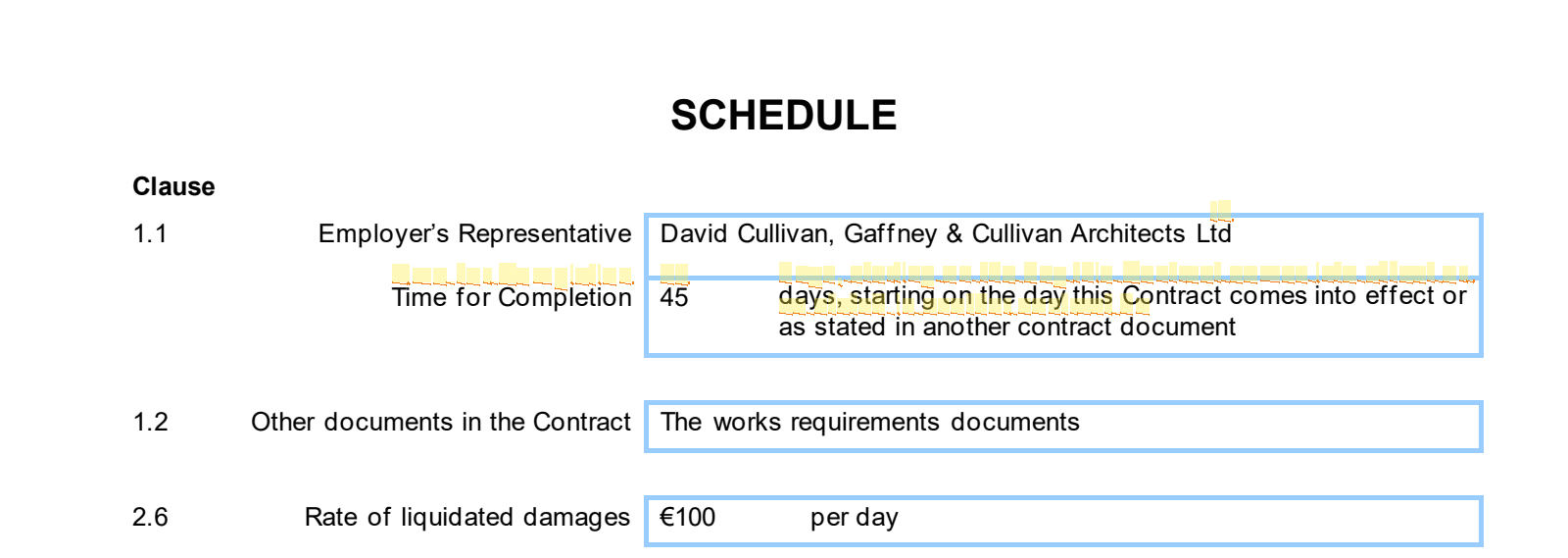
A 45-day completion period for new changing rooms and a gym is an extremely tight programme. This compresses all project phases, from detailed design coordination and material procurement to on-site construction and commissioning. Long-lead items, such as specific gym equipment or bespoke finishes, will be difficult to secure within this timeframe without significant expediting costs or pre-ordering at risk.
The compressed schedule also limits flexibility for unforeseen site conditions or subcontractor availability. Any minor delay, whether due to weather, supply chain issues, or coordination challenges within the operational sports complex, could quickly lead to programme overruns. This directly impacts prelims, resource planning, and the potential for liquidated damages if the contract includes them.
Time for Completion 45 days, starting on the day this Contract comes into effect or as stated in another contract document
What we'd do: Develop a detailed critical path programme, identify all long-lead items, and confirm subcontractor availability before pricing. Price in significant contingency for expedited procurement and potential overtime, or qualify the programme with a realistic duration.
Extended Defects Liability and Warranty Obligations
Critical · Defects Liability Overreach
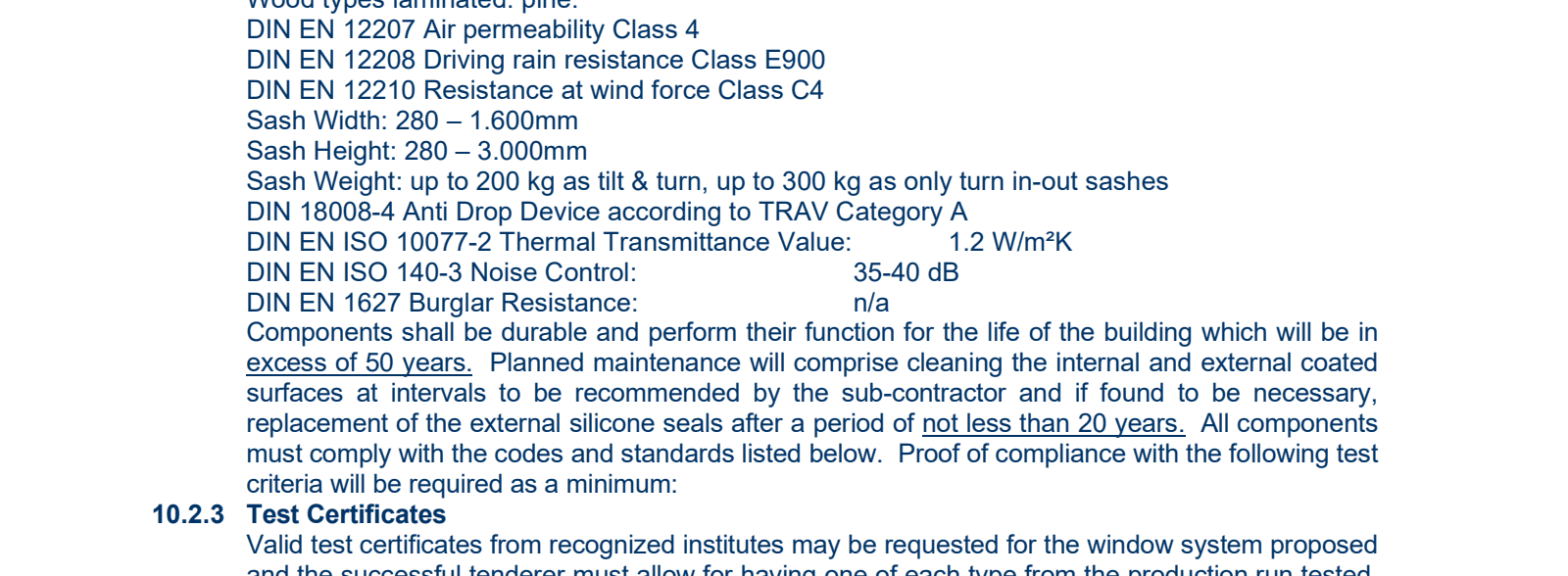
The contract specifies a standard 12-13 month Defects Liability Period but then introduces significantly longer warranty obligations, including 25 years for the roof system (with an insurance-backed warranty) and a general requirement for components to perform for "in excess of 50 years." Furthermore, product warranties are linked to the longer of the DLP or the manufacturer's warranty. This creates a substantial, long-term liability tail for the contractor that extends far beyond typical industry norms.
The commercial implication is that the contractor remains exposed to latent defects and performance failures for decades. While manufacturer warranties might cover product failure, the contractor's liability for workmanship and installation over such extended periods is a significant risk. Securing insurance for such long-term, specific warranties, especially for workmanship, can be costly or even unachievable, leaving the contractor self-insured for a considerable period.
Components shall be durable and perform their function for the life of the building which will be in excess of 50 years.
Roof System to include 25-year Insurance backed Warranty. ... This warranty will be a full and unconditional warranty (except for routine wear and tear) for the completed roofing installation. ... The warranty in respect of the workmanship will be in a form to be approved by the Architects for a similar duration to above.
What we'd do: Seek clarification on the exact scope and interplay of the Defects Liability Period versus the extended warranty requirements. Obtain firm quotes for the 25-year insurance-backed roof warranty and assess the feasibility and cost of insuring the 50-year component performance.
Contractor assumes full site condition risk and completeness of scope
Critical · Site and ground conditions
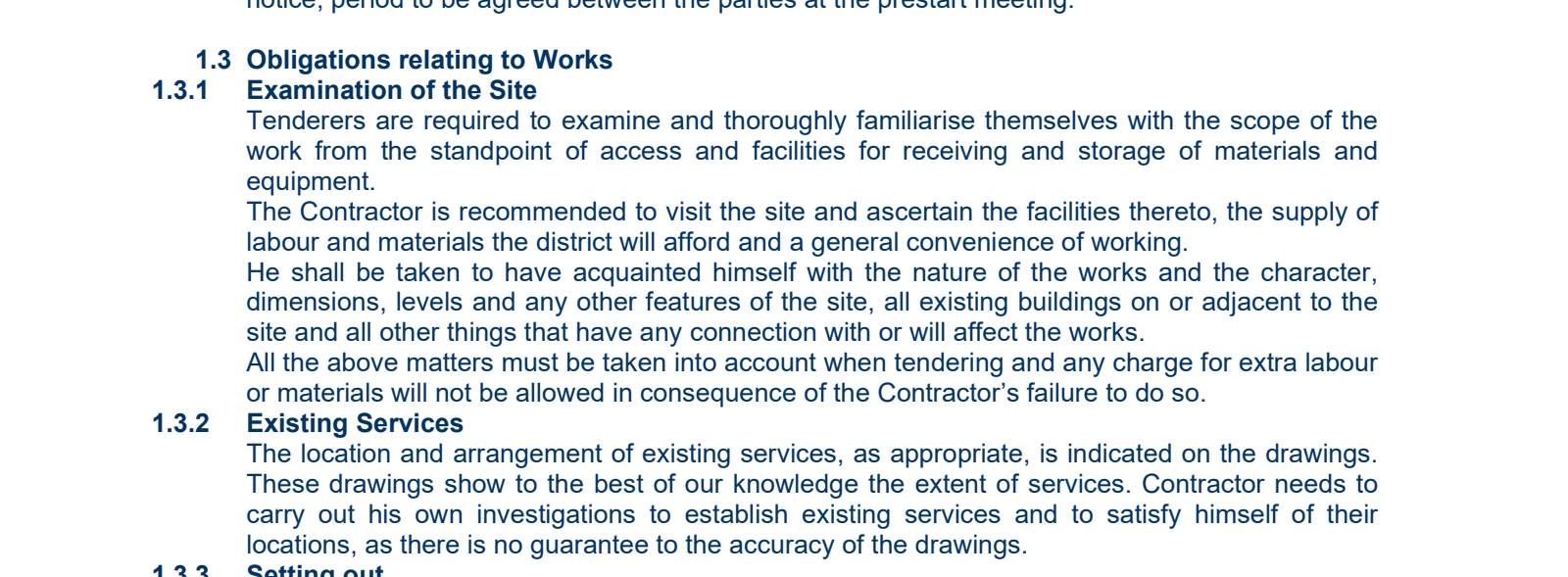
The tender documents explicitly state that the contractor is deemed to have thoroughly examined the site and all associated documentation. It further clarifies that no additional payment will be made for extra work or materials arising from a failure to do so, or for items "reasonably and obviously inferred as necessary" even if not explicitly described. This wording places the full risk of unforeseen ground conditions, existing services, and any scope omissions squarely on the contractor.
This means that if ground investigations reveal unexpected obstructions, contamination (beyond what's specified for asbestos), or if the existing building structure requires more extensive remediation than anticipated, the cost and programme impact will be borne by the contractor. The burden of proof for what was "reasonably and obviously inferred" will also fall to the contractor, creating potential for disputes and unrecoverable costs.
He shall be taken to have acquainted himself with the nature of the works and the character, dimensions, levels and any other features of the site, all existing buildings on or adjacent to the site and all other things that have any connection with or will affect the works.
The Contractor shall be held to have satisfied himself by a careful examination of the plans and specifications and by inspecting the site as to the amount of work to be done to enable the works to function satisfactorily. This shall include all items reasonably and obviously inferred as necessary, through not described in the specification nor shown on the drawings.
What we'd do: Conduct a comprehensive pre-tender site investigation, including intrusive surveys if possible, and document all assumptions regarding existing conditions and scope completeness. Price a robust contingency for unforeseen ground conditions and potential scope gaps.
Contractor bears all costs and responsibility for asbestos investigation and removal
Critical · Site and ground conditions
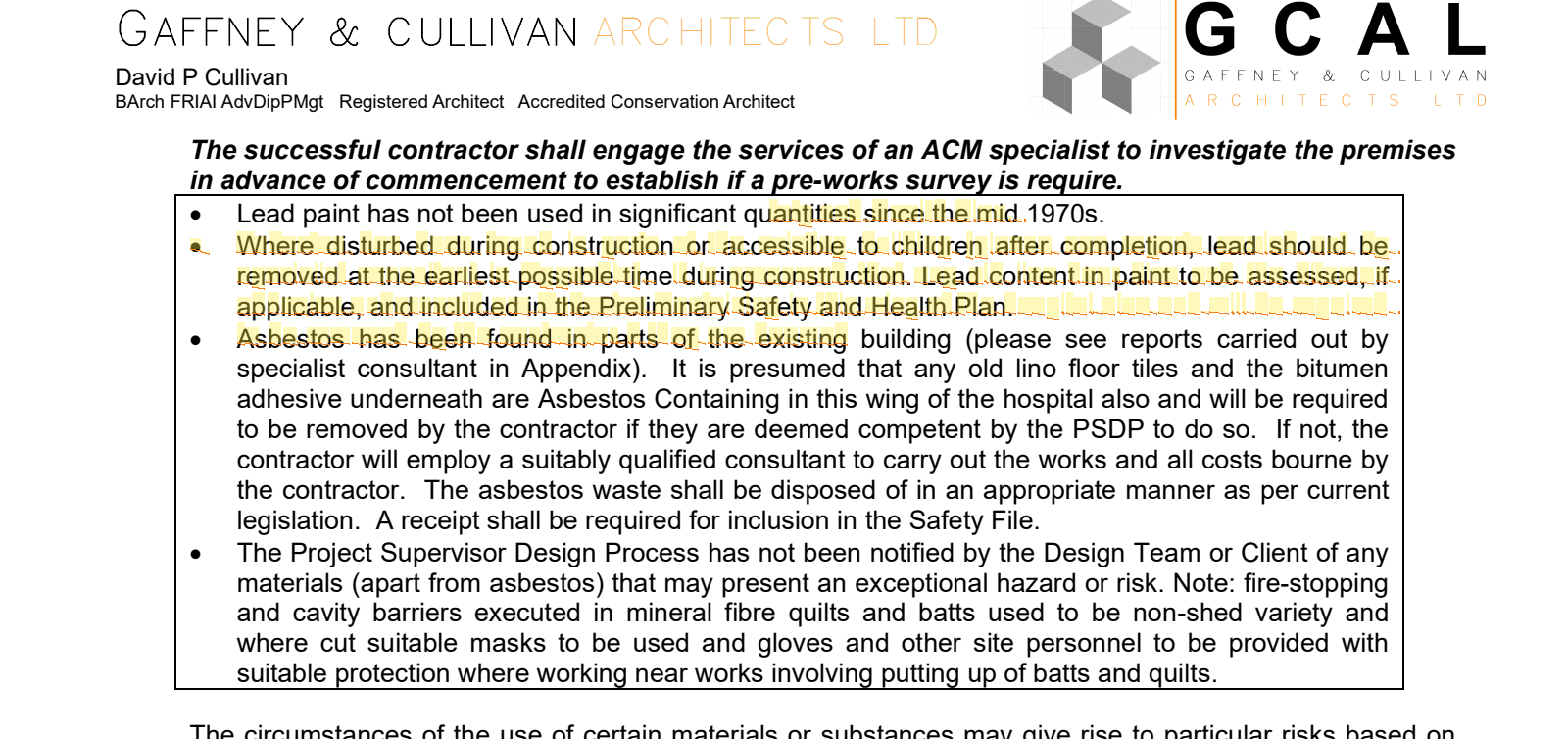
The tender documents explicitly identify asbestos as present or presumed present in the existing building, specifically mentioning old lino floor tiles and bitumen adhesive. The contractor is mandated to engage an Asbestos Containing Material (ACM) specialist for a pre-works survey and is fully responsible for all costs associated with the investigation and removal of these materials. This is a direct and significant cost and programme risk.
The commercial impact is twofold: first, the direct cost of specialist surveys, removal, and compliant disposal, which can be substantial and unpredictable depending on the extent of contamination. Second, the programme implications of specialist asbestos works, including strict safety protocols, licensing, and potential delays if unexpected quantities or types of asbestos are discovered. This work requires careful planning and coordination within the operational sports complex, adding to the complexity and potential for disruption.
Asbestos has been found in parts of the existing building (please see reports carried out by specialist consultant in Appendix). It is presumed that any old lino floor tiles and the bitumen adhesive underneath are Asbestos Containing in this wing of the hospital also and will be required to be removed by the contractor if they are deemed competent by the PSDP to do so.
The successful contractor shall engage the services of an ACM specialist to investigate the premises in advance of commencement to establish if a pre-works survey is require.
What we'd do: Obtain all existing asbestos reports and conduct a detailed pre-tender asbestos survey to quantify the extent and type of asbestos. Secure competitive quotes from licensed asbestos removal specialists and include these costs, plus a significant contingency, in the tender.
Disqualification for Incomplete Form of Tender
Critical · Portal Submission Failure
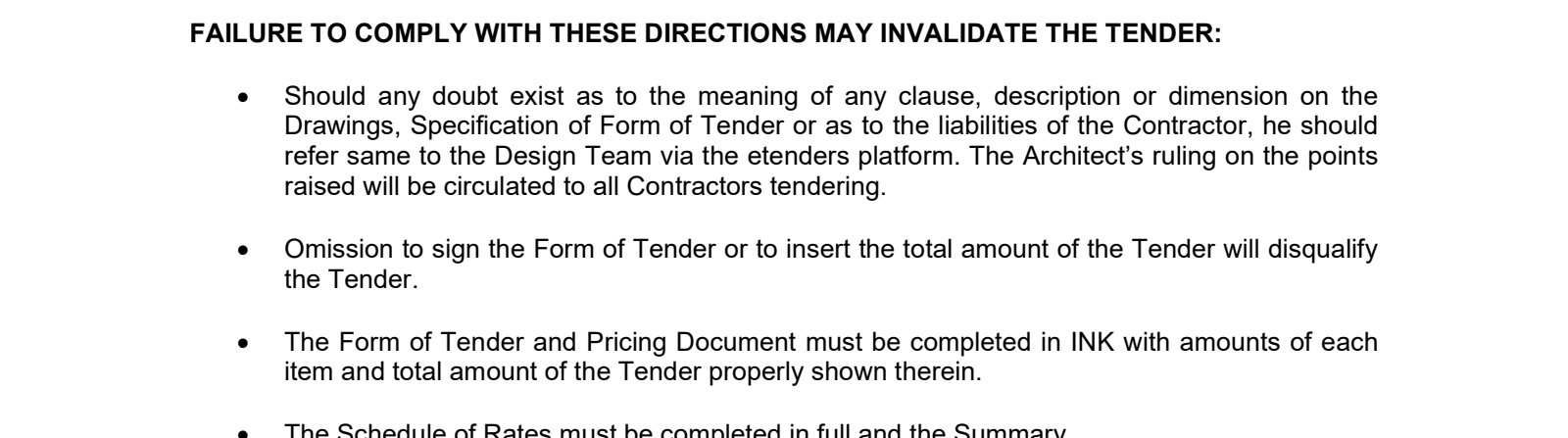
The tender documents explicitly state that any omission, such as a missing signature or the total amount on the Form of Tender, will lead to automatic disqualification. This is a critical compliance requirement that leaves no room for error or clarification post-submission.
For bid teams, this means that even a commercially competitive and technically sound proposal will be rejected if a basic administrative detail is overlooked. The risk is purely procedural but carries the highest possible consequence: zero chance of award. This requires meticulous attention to detail during the final stages of bid preparation and submission.
Omission to sign the Form of Tender or to insert the total amount of the Tender will disqualify the Tender.
The Form of Tender should be signed, stamped and dated and attached to the submission.
What we'd do: Implement a mandatory, independent two-person check for the Form of Tender, ensuring all required fields, including signature, stamp, date, and the total amount, are correctly completed and verified before submission.
The rest of the picture
Beyond the detailed risks, bidders should note the critical responsibility for existing services accuracy, investigation, and damage, which could lead to significant unrecoverable costs. The tender also mentions strict contamination and dust control requirements in a "sensitive hospital environment," which conflicts with the "rugby club" context and needs immediate clarification given the potential for heightened operational restrictions and costs. Furthermore, the 6-month tender validity period ties up bid resources and pricing for an extended duration, while the use of provisional quantities for works below ground level introduces further cost uncertainty that the contractor is largely expected to absorb. Finally, the general HSE risks of working in an operational sports complex adjacent to residential/commercial areas are pervasive and will require robust, priced-in management.
Takeaways
- Thoroughly investigate site conditions, especially for asbestos and existing services, and price in robust contingencies.
- Challenge the aggressive 45-day programme with a realistic assessment of procurement and construction durations.
- Clarify the extent of long-term warranty obligations and their insurability beyond the standard Defects Liability Period.
- Implement stringent quality control for tender submission, as omissions on the Form of Tender will lead to disqualification.
- Seek immediate clarification on the "hospital" versus "rugby club" discrepancy, as it impacts operational constraints and risk profile.